
Disclosure: The content on this page includes affiliate links. While clicking on these links won’t cost you anything extra, we may earn a modest commission from any purchases.

La Palma was the final stop on our Canary Islands cruise. Knowing how beautiful the island is, we booked a small car at the port in advance so we could explore on our own. We drove from Santa Cruz de La Palma toward Caldera de Taburiente National Park and took a short hike above the clouds. A rental car is practically essential if you want to see anything beyond the port town.
La Palma was the last stop of our Canary Islands cruise in December 2025 before returning to Gran Canaria. The island was new to us, and we especially wanted to see its striking green mountain scenery. We had booked a rental car to wait for us at the port, since we knew that in a single day, you hardly see anything on La Palma without your own wheels. Many cruise passengers choose ready-made excursions from GetYourGuide, but we decided to explore the island at our own pace, driving along winding mountain roads.

La Palma turned out to be very different from, for example, Lanzarote and Fuerteventura. The island is highly mountainous, the roads are winding, and driving is slow. In one day,y you only have time to see a small part of the island, even with a rental car.
La Palma is a lush island.
Renting a Car
We usually compare rental cars via Discover Cars, but only a few agencies were operating at La Palma’s port. We wanted a car directly from the port without shuttles or extra transfers, so we booked with TopCar, whose office was in the port terminal. So we broke from our routine and booked the car directly through the rental company’s website.
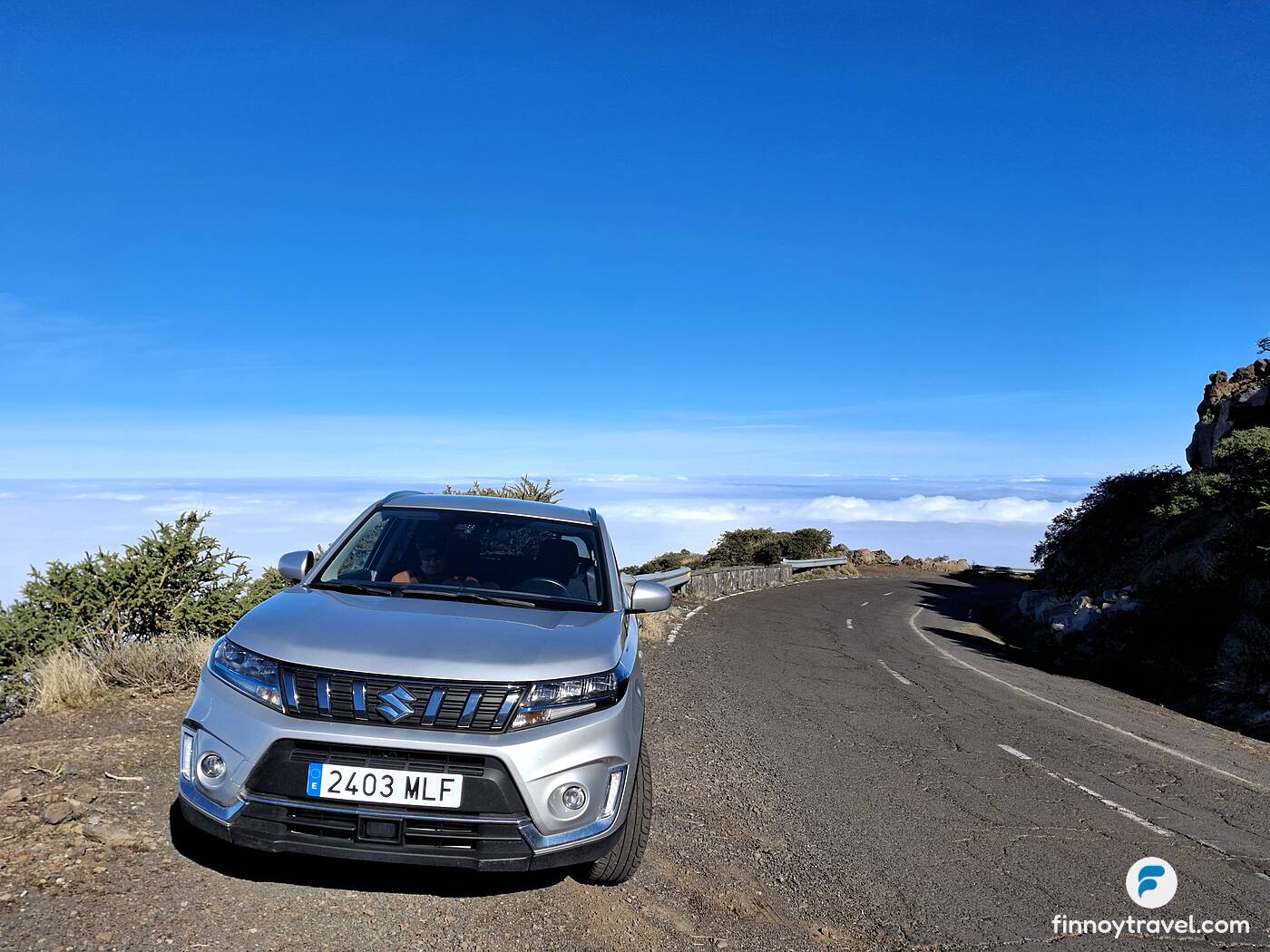
We had chosen a Toyota Aygo as our rental, but received a Suzuki from the same class. A small car proved an excellent choice for La Palma’s narrow, winding mountain roads. Driving a larger car would have been clearly more difficult. In the mountains, you don’t need much power, because the winding roads don’t allow even typical city speeds.
Picking Up the Rental Car
We handled the paperwork for pick-up smoothly at TopCar’s port office, but the line moved rather slowly. When it was finally our turn, we signed the contract quickly, got the keys, and found the car in the port parking area a short walk away. The little Suzuki seemed modest at first, but as the day went on,n it became clear that this size of car fits La Palma perfectly.

A few minutes later, we headed onto the streets of Santa Cruz de La Palma and from there continued toward the mountains.
Our Driving Route
Despite the challenges and a slightly delayed disembarkation, we were soon on our way from the port of Santa Cruz de La Palma toward the centre of the island and Caldera de Taburiente National Park. It became clear early on that progress is slow: the road twisted uphill without pause, and we moved along much more slowly than on, for example, Lanzarote.

Down at the port, the weather was cloudy and grey. Fortunately, La Palma—and several other Canary Islands—has the quirk that if you climb high enough, you end up above the clouds. That’s what happened to us. In under an hour, we were in bright sunshine, fresh mountain air, while a thick cloud layer rested below.
Hiking in Caldera de Taburiente
We left the car in a small roadside pull-off near Pico de la Nieve and set off on foot toward the summit. The hike took about 1.5 hours each way, and the path climbed steadily uphill. From the top, there were gorgeous views over Caldera de Taburiente National Park.

The mountain air was cool and the sky clear. The sun was shining, but the cold felt pleasant as we hiked. Around us, the greenery typical of La Palma spread: Canary pines, lush vegetation, and steep slopes whose scale only truly came across in person.

Toward the Observatory
We planned to drive to Roque de los Muchachos, the highest point on La Palma. However, the lack of a data connection caused navigation problems, and we inadvertently missed the junction. We eventually decided to continue toward the observatory area.

We ended up in an area with a large telescope antenna, but it wasn’t the main observatory site, just one individual telescope. By this point, so much time had passed that we no longer had time to head to the actual observatory or hike to the island’s highest peak.

We turned back toward Santa Cruz de La Palma and enjoyed the drive on this exceptionally beautiful mountain road above the clouds. The road is in good condition, and traffic in the mountains is typically light. Along the way, we even saw some snow. We drove calmly and stopped a few times to admire the scenery and take photos before the actual descent back to the coast.

On this route, the drive itself felt almost more impressive than the sights. With more time, we would certainly have stopped more often to explore the places along the way, because there is plenty to see in the views alone.
Return to the Port and Car Drop-Off
In the mountains, we drove much of the route in bright sunshine above the clouds, but on the descent, we met dense fog. Visibility dropped markedly, and driving required close focus. Even so, the descent to La Palma’s capital went smoothly.


When we arrived at the port, we encountered one more surprise: the gate to the parking area that had been open in the morning was closed, and we couldn’t return the car to the same place. With time running short, we had to leave the car in the McDonald’s parking lot next to the port and deliver the keys to the rental company’s mailbox. Google Maps also failed to suggest a sensible route to get around the closed gate.
Our Driving Experience on La Palma
Driving on La Palma differs clearly from, for example, driving on Lanzarote or Fuerteventura. At times it resembles driving on Gran Canaria, but La Palma offers greener scenery. Conditions are also demanding: the roads are extremely winding and the elevation changes are large, so transfers are slow.

Even if the navigator shows short distances, the travel time can stretch surprisingly long. In the mountains, the mobile connection is also patchy in places, which interferes with Google Maps.

A small car is an advantage on narrow roads, and parking in the mountains is effortless. In mountain areas, parking is mostly free, and paid spaces appear mainly in towns. Parking is one of the smallest challenges on La Palma.
Driving in the centre of Santa Cruz de La Palma was smooth, but even a small U-turn could take surprisingly long because many streets are one-way.
Tips for Driving on La Palma
Allow plenty of time for transfers. Even if the map shows short distances, winding roads, big elevation changes, and shifting conditions, it can slow you down significantly.
Prepare for changeable weather. It can be cloudy on the coast while the mountains are sunny. On the way back, the same route may pass through dense fog, reducing visibility considerably.
A small car is a clear advantage. Narrow, winding mountain roads are much easier to drive with a small car, and parking in roadside spots is effortless.
Drive calmly and anticipate. Sharp bends, fog, and constant elevation changes require focus, even if the road is in good condition.
Plan your route carefully. You won’t have time to see many places in a day, so focus your route on the essentials.
Bottom Line
La Palma is a green paradise for hikers and an island where a rental car is practically essential if you want to see more than Santa Cruz de La Palma. One day behind the wheel only scratches the surface, and La Palma has enough to see for several days. Most of the time goes into driving on mountain roads, but the destinations are rewarding.
Although we didn’t manage to do everything we had planned during our short visit, the experience was still unique. Driving above the clouds in the sunshine and hiking in Caldera de Taburiente stood out especially. La Palma is an island we want to return to. For cruise passengers, we can recommend renting a car, as it lets you freely reach exactly the places you want to see.
The commenting feature has been removed due to low usage. The discussion continues in our Facebook group — you’re welcome to join!

