Disclosure: The content on this page includes affiliate links. While clicking on these links won’t cost you anything extra, we may earn a modest commission from any purchases.

In December 2025, we set off on a week-long Canary Islands cruise aboard MSC Musica. The cruise included full board and accommodation, and along the way we stopped at several of the Canary Islands. Departure was delayed due to a storm, which caused some confusion in the port, but after that, the trip went mostly according to plan. Overall, the cruise was a convenient and reasonably priced way to visit several islands in a week, even though the ship is neither the newest nor the most luxurious.
Looking for a Winter Cruise
As autumn evenings grew darker, we browsed cruise deals for late 2025. The best ships – and, surprisingly, the lowest prices – seemed to be on Central European itineraries. A cruise around dark and rainy Europe, however, did not feel like an appealing winter holiday, so we started looking at options around the Canary Islands. We ultimately chose MSC Cruises, and the ship ended up being MSC Musica, even though it is not among the newest vessels.
In this review, we share our experience on the cruise and evaluate the ship itself. We cover booking the cruise, the departure delay caused by a storm, the itinerary, onboard services, food and entertainment, and how practical matters worked in the ports. At the end, we also consider who we think this kind of cruise would suit.
Why We Chose a Canary Islands Cruise
A cruise around the Canary Islands appealed mainly because it was easy and the winter weather is relatively favourable. In winter, the Canary Islands are among the warmest destinations in Europe, with pleasantly mild temperatures and clearly longer daylight hours than in Finland. The cruise also made it possible to visit several Canary Islands that were new to us on a single trip, without changing hotels or planning transfers separately. During the day, you could go ashore and explore each destination, and at night, the ship sailed to the next port.

Our decision was also influenced by the fact that Finnair sold reasonably priced business class flights to Gran Canaria for Avios points on a wide-body A350 aircraft. Once suitable flights were available, a Canary Islands cruise felt like a well-rounded choice, as we could see several islands on the same trip. Our previous Mediterranean cruise on Costa Toscana had also left us with a positive impression of cruising as a way to travel.

Our Cruise Experience
Booking on the MSC Website
We compared prices as usual using online comparison tools, MSC’s own website and several travel agents. Many companies sell Canary Islands cruises. It is worth seeing price comparison as more than just a chore, because you also get to learn about the practicalities of the cruise in advance.

In the end, we booked directly on MSC’s own website. After careful comparison, the lowest price seemed to be from booking directly with the cruise line, and the mandatory service charges were included. The booking process on MSC’s site was clear and straightforward. After making the reservation, we paid a small deposit, and the remaining balance fell due about a month before departure.
The cruise costs around 650 euros per person, which is a very reasonable price for a week-long Canary Islands cruise. Mediterranean cruises can be even cheaper, but in winter, they are not the best choice because of the weather. Mediterranean cruise prices also rise as demand increases towards summer.
Our fare included full board, accommodation in a standard cabin, transport between the islands and entertainment, so overall we felt it offered good value for money. The schedules of the flights we booked separately were also so convenient that we did not need hotel nights at either end of the trip. That said, it is best not to cut timing too fine, as flights can easily be delayed by a couple of hours.
Itinerary
Our route went from Gran Canaria to La Palma, then on to Tenerife, Fuerteventura and Lanzarote. After that, we had a sea day before a second stop in La Palma and the return to Gran Canaria. The itinerary usually includes Madeira as well, but on our departure, Madeira was not part of the programme and had been replaced by a second stop in La Palma. Even so, the five Canary Islands we visited over the week already offered plenty to see.

We liked the itinerary because the distances were short and we had more time than usual in each port to explore. The route stayed close to the Canary Islands throughout, so the weather remained fairly similar for the whole trip. In most Canary Island ports, the harbour is near the city centre, so you can quickly reach nearby activities without needing a taxi or other transport.
The Start of the Trip
The trip did not start exactly as planned. As we arrived in Gran Canaria, a storm was building up, and the ship was already running late. It reached the departure port, Las Palmas, clearly behind schedule, which meant embarkation was delayed by about six hours.

Normally, passengers are given an individual check-in time. Ours was 13:00, which felt quite tight, as our scheduled landing time was only 12:00. However, we had pre-booked a ride from Las Palmas airport to the port with Welcome Pickups, so we assumed we would make it on time. The day before departure, we already received slightly confusing text messages from MSC about the delay, with the new estimated check-in time fluctuating between 17:00 and 19:00. We were not particularly worried about this uncertainty, as we expected to arrive at the port around 13:00 anyway.
The beginning of the journey was the weakest part of the whole cruise. The storm had disrupted the port’s check-in arrangements, and the situation quickly became confusing. The text messages we received in advance were contradictory, and there was no clear information on the site about what was happening or when we would finally be allowed to board. There were also very few MSC staff members visible at the port to guide passengers. After a long travel day, waiting outside felt frustrating. MSC made a poor first impression, but fortunately, it did not last.

Once we finally got on board, the arrangements ran much more smoothly. As compensation, we received $ 30 in onboard credit. The amount was modest but better than nothing. It did not erase the confusion of the departure day, but it was at least a small gesture from the cruise line.
Missing Our First Stop in La Palma
The storm also affected the itinerary. The first stop in La Palma had to be cancelled entirely, and the ship remained in Las Palmas for 24 hours. This was disappointing because we had especially looked forward to visiting La Palma. We had booked a rental car for the island, but fortunately, we were still able to cancel the reservation. The storm was severe, and we were glad the ship did not head out to sea before conditions improved.
Luckily, La Palma appeared twice on the schedule because Madeira had been dropped from this particular cruise. We did not completely lose our La Palma visit, but we reached the island later in the trip. That took the edge off the disappointment.
In practice, the ship remained in Las Palmas port for the first 30 hours or so, but passengers were free to go ashore, and we used the time for some shopping. Because of the storm, being outdoors was neither very pleasant nor entirely safe. The ship’s facilities and restaurants, however, were operating normally from the first day.

How the Cruise Went After the Initial Problems
After the early setbacks, the rest of the cruise ran according to the published programme, with the planned schedule and ports of call.
Practical Cruise Arrangements
Overall, the cruise was a smooth and effortless experience. The ship mainly sailed overnight, so the days were free to explore the islands. Even though the sea was not perfectly calm, the journey felt surprisingly comfortable.
The major advantage of this kind of cruise is that the transfers between destinations happen almost without you noticing. You can spend the day ashore, enjoy a leisurely dinner on the ship in the evening, and wake up the next morning in a new place. There is very little practical organising to worry about because everything is arranged for you. On the sea day, you can focus on enjoying the ship’s facilities.
Easy Disembarkation and Reboarding
Port formalities on this Canary Islands cruise worked very efficiently. Going ashore was quick because there are no passport checks within the Schengen Area. Often, we were off the ship in about five minutes, and returning was almost as fast. You have to be back on board at least 30 minutes before departure, so it is wise to arrive at the port in good time.


The speed and simplicity made the whole cruise feel very effortless. Ports in the Canary Islands are usually located in or very close to the main island capitals, so getting around is easy as soon as you step off the ship. If you want to focus on exploring the Canary Islands’ towns and cities, a cruise is an excellent option.

Food and Drinks On Board
Full board was included in the cruise fare. In practice, food was available almost continuously in the ship’s buffet restaurant. Lunch and dinner in the à la carte restaurant were also included at no extra charge. Speciality restaurants, cafés and some premium items came with a surcharge.

There was plenty of food. The selection, however, was fairly standard. Our impression was that MSC kept the flavours quite safe so they would suit as many guests as possible. The idea is understandable, but we would have liked a bit more character and bolder tastes. We would probably have found that at speciality restaurants, but we did not want to pay extra for meals.


Without a drinks package, the cruise fare included water and coffee, plus juice at breakfast. Other drinks, such as speciality coffees, cost extra. The drinks packages seemed quite expensive and did not feel particularly worthwhile to us. For that reason, we would not recommend buying a package by default. If drinking is not the main focus of your cruise, paying for drinks individually usually keeps your total costs relatively low.


Entertainment On Board
Entertainment was included in the cruise price, and there was a lot of it. Every evening, there was a main show, which we found surprisingly high quality. There were also karaoke sessions, live music and other evening entertainment in the ship’s different venues. The programme was multilingual, but you did not generally need strong language skills, as many performances were focused on music. During the day, there were also various competitions that you could join with fairly basic English.

Entertainment was one of the areas where MSC Musica exceeded our expectations. In the evenings, there genuinely was plenty to do, and the atmosphere did not rely solely on bars and restaurants.


Information and Communication
Most onboard information was delivered through MSC’s mobile app, which you download to your phone, and there were very few paper notices. The app worked reasonably well, but it was not ideal. It contained the basic information we needed, but the interface was not particularly intuitive. Unlike many other cruise lines, MSC does not distribute traditional printed daily programmes to the cabins.
The app allowed us to see onboard charges in real time.
An app-based system works well when everything runs according to plan. In exceptional situations, such as those caused by storms, clearer, more visible communication would be helpful.
Safety information was available in several places: in the app, on the safety video looped on the cabin TV and on the cabin walls. The most important instructions were also covered in the mandatory safety briefing. Every passenger also had to visit their own muster station to know its location.

The ship also sold various add-on services. The spa offered, among other things, saunas and massages. We did not feel the need to visit the spa, and there would not really have been much time for it in our schedule anyway.
There was a gym on board, which guests could use free of charge.
The most expensive but potentially most useful extra service was Wi-Fi. When the ship is at sea, mobile data connections are weak, so frequent internet users may need Wi-Fi. However, the price was quite high. If you do not need to be connected all the time, Wi-Fi is not essential on a Canary Islands cruise. Mobile networks work well ashore, and at sea, there may sometimes be enough signal near the windows. The MSC mobile app works even without a paid internet connection.

Our Assessment of MSC Musica
Overall Look and Feel of the Ship
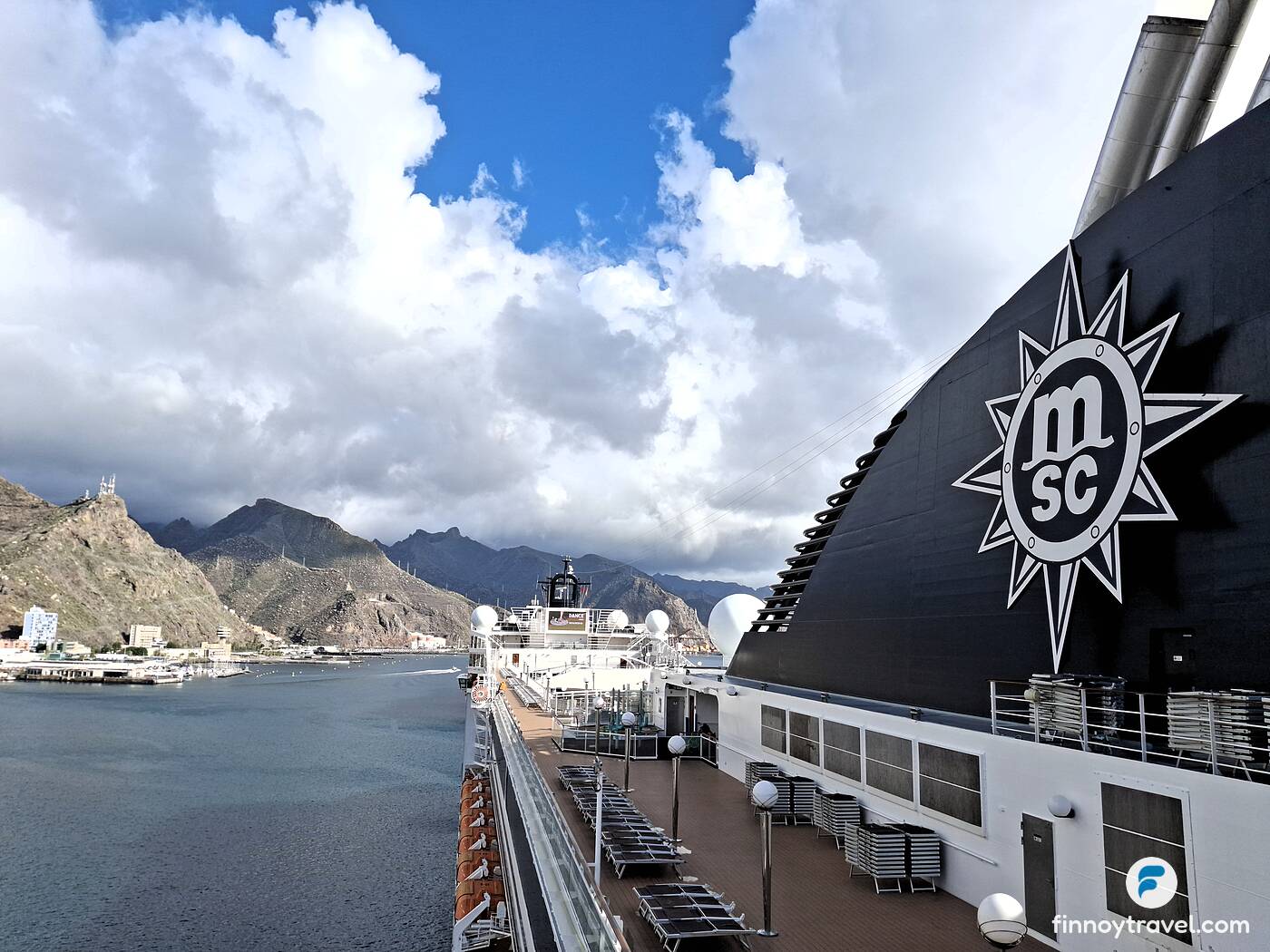
MSC Musica is not a new ship, and that shows in its overall appearance. Some of the decor felt a little dated, although several bars and restaurants had been stylishly refurbished. At times, the atmosphere was reminiscent of a Viking Gabriella–style cruise, but in a more international version. The interior clearly reflects retro-style cruise aesthetics, which will not appeal to everyone. If you are specifically looking for an ultra-modern vessel, MSC Musica is not the right choice.
That said, the ship did not feel worn out. Even though the layout is older in style, the vessel has been well renovated, is clean and is clearly well maintained. The look is not modern, but everything feels neat and cared for. With the right expectations, the ship can be a pleasant surprise.
Cabin and Public Areas
We had an inside cabin on deck 9 with no window. In many ways, it resembled the cabins on Finnish–Swedish ferries, but it felt a little more spacious. The cabin was not luxurious, but it was practical, clean and comfortable enough as a base for a week. Although there was slightly more room than in typical Baltic Sea cabins, it still felt a bit cramped. We would recommend booking a higher cabin category if you plan to spend a lot of time in your room.

MSC Musica is a mid-sized ship, somewhat larger than many traditional cruise ferries. We quickly learned our way around and found different areas easily. On our previous cruise on Costa Toscana, by contrast, the first days were more confusing because the ship was so big that it took a while to learn where everything was.
Outer Decks, Pool Area and Outdoor Conditions
The outer deck has a swimming pool and several hot tubs. In sunny weather, it is a pleasant place to spend time, and on warm-weather itineraries, the outdoor spaces are an important part of the overall experience. In the Canary Islands’ climate, the outside areas really come into their own.

The pool water felt a bit too cold for us. It was also often quite windy on deck. That was not exactly surprising on the Atlantic in winter, but it did affect how long we wanted to stay outdoors without moving around.

Shops
There are a few shops on board, but they are nothing like the large tax-free stores on Baltic ferries. Shopping options were quite limited, and this ship was not particularly attractive for dedicated shoppers. The selection mainly consisted of electronics, branded goods, clothing, souvenirs and a small range of sweets. The shops make for a bit of light entertainment on a sea day.
English, Spanish and several other languages were used in customer service. If you manage in the Canary Islands in general, your language skills will be sufficient on the cruise as well. It is also worth noting that there were plenty of Finnish passengers on board.
Customer Service On Board
After the initial confusion in the departure port, service on the ship was professional. The crew did their jobs smoothly, and the basics worked very well. In particular, service in the restaurants, housekeeping and general service points ran without major issues.
We were left with the impression that MSC’s biggest challenges lay in communication during exceptional situations rather than in the service delivered on board. Once the ship was sailing normally, everything felt well-managed. Smooth, timely communication seems to be MSC’s weakest area.
Rating
We rated our Canary Islands cruise on MSC Musica as a 3.5-star experience. After the early difficulties, things were handled professionally, and the cruise delivered on its promises. The ship does not compete with the very newest vessels, but it is still a pleasant way to travel. There was plenty of food, even if the selection could have been a bit more varied. In any case, a Canary Islands cruise is an excellent way to see several islands in one week.
Who a Canary Islands Cruise on MSC Musica Suits
In our view, MSC Musica suits travellers who are looking for a traditional cruise experience at a reasonable price. It is not a cutting-edge luxury ship or a design showcase, but it is clean, functional and comfortable enough for a week-long trip. There was a wide variety of passengers on board, from young couples to families with children and seniors. There were perhaps slightly more seniors than average, which is understandable as many retirees live in the Canary Islands and a cruise is an easy way for them to holiday without travelling far from home.

Because the ship does not try to impress with cutting-edge style, it suits relaxed travellers well. There was no strict dress code on board. However, very revealing outfits were not appropriate for the theatre and restaurants. Basic language skills are enough for a Canary Islands cruise – everyday English or the local language will do just fine.

MSC Musica is particularly suitable for travellers who care more about the itinerary than the ship itself. The Canary Islands’ ports and easy island-hopping are the cruise’s biggest draws. Las Palmas Airport is only about a 40-minute taxi ride from the port, and you can get there cheaply by bus or for a reasonable fare by taxi.
Bottom Line
All in all, our cruise on MSC Musica was a positive experience despite the small problems at the start. The delay and confusion caused by the storm eventually turned into just one episode on an otherwise smoothly run trip. Once the ship got back on schedule and settled into its routine, the overall experience felt well organised and enjoyable.
A Canary Islands cruise proved to be a particularly good way to see several islands in one week. During the day, we could explore new places and in the evening return to the ship, where all the practical arrangements were taken care of. This made it an easy and low-stress way to travel somewhere warmer in winter.
If you are considering a reasonably priced Canary Islands cruise, MSC Musica is a serious option. It may not be the most spectacular ship in the cruise world, but it provides a practical and pleasant setting for a holiday. With the right expectations, it can offer a very enjoyable way to spend a week on the Atlantic, hopping from island to island. It is still worth comparing alternatives, as several stylish ships cruise around the Canary Islands.
The commenting feature has been removed due to low usage. The discussion continues in our Facebook group — you’re welcome to join!